
What Is Salt Therapy?
Salt Therapy: What Happens in a Salt Room?
Salt therapy is also known as halotherapy. A machine breaks salt into fine particles and releases them into the air while visitors sit in the room. But not every place advertised as a “salt room” uses this equipment. Some have salt-covered walls without anything dispersing salt into the air.
That’s worth asking about before booking. Two rooms can look much the same in photographs but offer different experiences.
Be sure to check out our Himalayan salt lamp collection and Himalayan salt collection.
What Is a Salt Cave?
At a spa, the name doesn’t necessarily mean you’ll be going underground. It can be a purpose-built room with salt bricks on the walls and loose crystals spread across the floor. Backlighting behind the bricks brings out their pink and orange colouring, while chairs provide somewhere to sit during the session.
Other rooms have a simpler layout. Low lighting and background music are common features, but neither tells you whether the room has equipment for releasing salt particles. They are part of the setting.

What Does a Halogenerator Do?
A halogenerator is the machine used in an active salt room. It breaks dry salt into very small particles and disperses them into the room. This is what separates an active session from simply sitting beside salt walls or lamps.
You may also come across the term passive salt room. This describes a salt-filled room without a halogenerator. The salt forms part of the surroundings, but there is no machine producing a dry-salt aerosol.
Ask the venue which arrangement it uses. A description mentioning Himalayan salt walls doesn’t answer that question on its own.
Are Himalayan Salt Lamps the Same Thing?
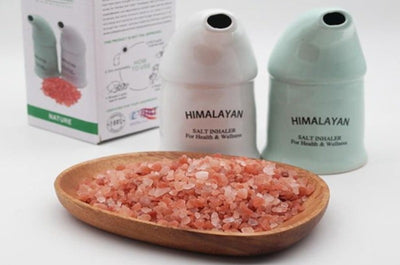
No. A standard Himalayan salt lamp has a light source inside a piece of rock salt. The light shines through the salt; it has no mechanism to grind it or disperse particles into the room. A lamp and a halogenerator are different pieces of equipment.
A lamp can provide part of the appearance associated with a salt room, but placing one beside a chair doesn’t recreate an active salt-room session.
Our Himalayan salt lamp collection includes different shapes and sizes for decorative lighting. You can also browse the Himalayan salt collection, checking each product’s intended use rather than treating all salt products as interchangeable.
Does the Machine Use Himalayan Pink Salt?
The pink salt on the walls may not be the salt going into the machine. Some halogenerators use purified, pharmaceutical-grade sodium chloride supplied separately from the decorative salt bricks. A room can therefore have Himalayan salt walls without using pink salt in its generator.
Ask what the machine uses rather than going by the room’s appearance. “Made with Himalayan salt” could describe the walls or flooring, so it helps to know which part of the room the description refers to.





Is a Salt Room Hot Like a Sauna?
Not necessarily. Some dry salt rooms are kept around ordinary indoor temperature. You sit in your own clothes rather than changing for a hot sauna session.
There are also purpose-built cabins that combine a halogenerator with an infrared sauna. These are a different setup, which is why the words “salt room” alone don’t tell you how warm it will be inside.
Before visiting, ask about the temperature and what to wear. That gives you a better idea of what to expect than photographs of glowing salt walls.
Why Might You Not See the Machine?
The halogenerator doesn’t always sit inside the room with you. Some models are fitted outside, with an opening through the wall that allows the salt particles to enter. This arrangement also gives staff access for refilling, cleaning and maintenance.
So a room without an obvious machine isn’t necessarily a passive salt room. There may only be a small outlet visible from your chair.

Can You See the Salt in the Air?
Not necessarily. Airborne particles can be too small to pick out with the naked eye. Clear-looking air can still contain fine particles, so looking across the room isn’t a reliable way to judge what’s in it.
Some halogenerators use sensors to monitor the salt concentration during a session. That is a measurement of the airborne salt, rather than a judgement based on how cloudy the room looks. Not every machine has the same controls, so this is something to ask about when comparing venues.
Is a Halogenerator an Air Purifier?
No. The two machines have different jobs. A halogenerator adds salt particles to the air. An air purifier with a particle filter is designed to capture particles as air passes through it.
Ventilation is another part of the setup. It brings in replacement air, while filtration removes some of the material carried in the air. Even an air purifier doesn’t remove every pollutant or replace the need for suitable ventilation.
When asking how a salt room is run, separate those questions: what releases the salt, what filters the air and how is the room ventilated?
How Is a Salt Room Cleaned?
The chairs, door handles and other surfaces people touch still need regular cleaning. Salt-covered walls don’t tell you anything about how well those parts of the room are looked after. General cleaning guidance for shared facilities puts particular attention on frequently touched surfaces.
Ask what happens between bookings. Are the seats wiped down? Are fresh blankets or washable covers provided? How are shared items looked after? Fabric items need cleaning methods suited to their material, just as hard surfaces do.
Some operators also run an exhaust system between sessions to remove room air and remaining airborne salt. That is separate from cleaning the furniture, so it makes sense to ask about both.